Minimalist loop puzzle that mixes Minesweeper counting and Slitherlink
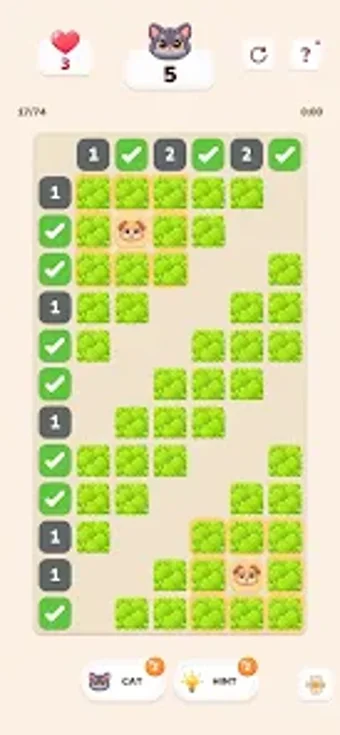
Linesweeper from Vlad Vlashchenko is a minimalist Android puzzle about building a single continuous loop across numbered grids, blending Minesweeper-style proximity counting with Slitherlink-like loop construction. The app uses eight-neighbor numeric clues and a garden theme with invisible cats and Checkers characters to guide deduction. It emphasizes a "never guess" philosophy so every puzzle resolves through logic. Fans of Minesweeper, Slitherlink, and methodical logic puzzles gain a portable, offline deduction challenge suited to focused sessions.
What kind of puzzle is this hybrid loop-counting game?
The app blends two familiar puzzle traditions: proximity counting inspired by Minesweeper and loop construction akin to Slitherlink. Players draw a single continuous circuit that never branches or crosses itself, and numbered cells block the path. Each number reports how many of the eight surrounding cells the loop occupies. That coupling turns local numeric clues into wide-reaching constraints, so a single deduction often forces multiple placements across the grid.
Does it have multiplayer mode or social features?
It targets solitary solving rather than shared play; the design operates offline with no multiplayer component. Support features focus on individual reasoning, notably an Undo action and progress tracking to record partial solutions. Levels are built around a 'never guess' approach that ensures puzzles are solvable by logic alone, which directs the app toward careful analysis rather than speed or competition.
What does the game look and sound like?
The visual direction keeps elements pared back so the grid stays central: clean shapes, restrained colors, and compact iconography. A light garden narrative frames levels with "smug, invisible cats" and playful Checkers characters, adding character without clutter. The developer's background in minimalist puzzle titles shows in tight visual feedback and modest audio cues, producing an environment built for concentrated deduction on Android devices.
How steep is the learning curve and what keeps you coming back?
Difficulty scales across multiple tiers and a large variety of grid challenges, so play sessions can be brief or extend into longer, demanding puzzles. Higher-level boards deliver layered complexity that rewards sustained attention, and the app preserves progress between sessions so you can return to unfinished puzzles. The core idea derives from a Jak Marshall puzzle concept adapted to mobile by the developer, which gives the title a familiar yet distinct problem-solving rhythm.
Best suited to patient, methodical puzzle solvers
The app is an inviting, patient choice for people who enjoy careful deduction and steady problem solving, because its design privileges logic over chance. Players seeking fast reflex tests or social competition may find it less satisfying. The experience rewards uninterrupted attention and fits sessions where you want a slow, satisfying reasoning exercise rather than bite-sized arcade thrills.